1990 Canadian Sailcraft CS34 Shoal Draft
Sail #8268

1982 Catalina 22 Fin Keel
Sail #10506

1994 MUMM 36 ACE
Sail # 29206

Featured Post

CS34 Still Time Part Out

Parting out 1990 CS34. This post will be pinned to the top of my blog. Here is a list of what is coming available: Sails  https://svstilltim...

Wednesday, January 19, 2022

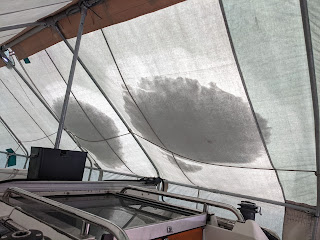
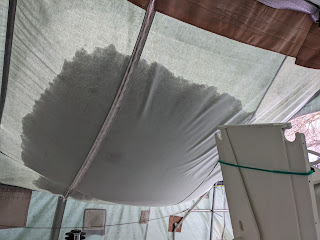
CS34 Winter Cover Snow Buildup

Fellow WYC member Doug Morgan texted me saying I should get down to the boat to address the accumulation of snow on the cover. 

With the 2ft dump of snow we had on Monday, nothing was on the cover when I checked on Tuesday afternoon.  Well overnight it warmed up from -22C to around 0C, and we got another 2" of heavy snow.


Accumulation from the inside:


Was able to knock it off with a hockey stick I had in my truck.

We are supposed to get freezing rain tonight and the additional weight of the snow and ice would for sure have damaged the cover!

Thanks Doug!


Monday, January 17, 2022

Google 2021 Review

 Google says I need to do some more sailing:


...and maybe some more walking!

Meanwhile in Bowmanville:


Wednesday, January 12, 2022

MUMM 36 ZAMBONI Sail Measurements

It is time to optimize our PHRF rating, as IRC/ORC is still born on Lake Ontario.

Over the weekend, I went out to Mike's farm in Dunnville with Mark and Phil to do some sail measuring.

ZAMBONI has the following sails:

  • main
  • light #1
  • heavy #1
  • #2
  • #3
  • #4

All of these are in good shape (except for maybe the light #1).

When we had a new main made by Durk Steigenga in 2019, we had him maximize the roach for the most sail area without penalty.  In 2020, PHRF added a requirement for the Mid Girth Measurement which is the girth at 7/8 height of the sail.  Durk calculated this measurement from the sail design program that he uses, but we were assessed a 2 sec/mile penalty for being 102% oversized.

We layed out the sail in the barn and confirmed  MGT dimension is smaller, so therefore no penalty.


MAN it is a big sail!  Also surprised by the weight of it.


We also measured our headsails:

  • #1 153% (this is on our PHRF cert)
  • #2 142%
  • #3 95%

We never have measured our smaller foresails.
ZAMBONI sails really well with a #2.

http://svstilltime.blogspot.com/2021/10/mumm36-zamboni-asym.html

The main drives more and gets less of a backwind bubble.

So we are thinking of dropping our #1 sails which would result in an adjustment of +2 to our rating.  Heck our next new headsail could be 135% for a PHRF adjustment of +4. 


We also measured our spinnakers:

  • fractional "Aloha" (standard size)
  • fractional "Evo" (standard size)
  • fractional "Big Blue" (oversized)
  • masthead "Franken Chute" (oversized)
  • masthead "Tiffany" (oversized)
  • masthead "Code0" (oversized)

We purposely use a 10% oversized spinnaker pole so that we can have more sail area in light winds.

The standard sail area for spinnakers for a MUMM 36 is 832 sqft.

Fractional "Big Blue" has been measured and is the biggest spinnaker we fly for PHRF racing.  Big Blue is 915 sqft (or 198%) for a PHRF ratings hit of  4 sec/mile.

We are fine with this because a MUMM 36 is designed for ocean racing where the wind is always 15-20 knots.  On Lake Ontario, the average wind speed is definately less and 10 knots and many times under 5 knots.  We need this additional sail area to be competitive.

When the wind is blowing 15+ aft of beam, we can be competitive with any boat on the lake using regular fractional chutes!  This doesn't happen too often however.

When we lost the mast in 2018, we had Steve Killing design and Klacko Spars build us a new mast that will allow masthead spinnakers for more sail area.   These masthead chutes can only be flown in less than 10 knots of breeze because the top 9 feet of the mast is unsupported.

We had our relatively new fractional oversized AIRX600 (same size as "Big Blue") chute built by Durk recut for a masthead hoist.  The additional cloth added to the middle is lighter than the rest so we call it "Frankenchute".  This made the chute 988 sqft (or 214%) for a PHRF ratings hit of 7 sec/mile.  We DO NOT carry this chute for PHRF racing (only IRC/ORC).

We also purchased a oversized Asym and a Code 0 from UK sails when they closed their loft in Toronto in 2019.  The A2 "Tiffany" (because of its colour) is an oversized asymmetric chute that we only fly under IRC/ORC.  If we were to put it on our PHRF cert, it would come in at 1112 sqft (or 241%) for a penalty of 13 sec/mile.

We have never been able to fly the Code 0 successfully.
It is too short for a masthead hoist, and too long for a fractional hoist.
Designed for a Beneteau First 10R.
We should have it re-cut to fit fractionally.  A code 0 puts too much force on the bowsprit and the unsupported masthead.  This would make up for dropping our #1 headsails in light winds.


The standard PHRF rating for a MUMM 36 is 48.

Last year our PHRF rating was 42.
-2 for oversized main
-4 for oversized spin

Optimizing PHRF rating for next year has a couple of options.

+2 drop #1
-4 for oversize spin (PHRF 46)
-7 for masthead spin (PHRF 43)

We could also drop the symmetric chutes and pole for a +6 rating adjustment.

+2 drop #1
+6 drop pole
-13 for A2

For a PHRF rating of 43.

Hmmm, we would also need some fractional asyms to round out the inventory.


NOTE: we still have to get our sails officially measured.

Friday, November 26, 2021

C22 Blast from the Past

I have had this blog going since 2011:

Monday, May 9, 2011

2011 Blog

After having my sailboat and sailing adventures on a private board last year,
I have decided to use Blogspot to make it more accessible.

My boat is a 1982 Catalina 22 Fin Keel, sail number 10506.

I have owned the boat since August of 2008.

I am now a member of the Whitby Yacht Club.

Just last week, I was cleaning up some bins I removed from the boat and came across:


This is no ordinary golf pencil; it has a story!

Unfortunately the private board from 2010 is no longer around.

So it was late October 2010 at Newcastle Yacht Club.  Most of the boats in the marina were hauled out, and I decided I wanted to go for one more sail.  

I had had Still Time for two seasons, and was learning and working out the bugs of the boat.  One of the problems was that the jib tracks leaked when sailed hard, or during rain.  Water would leak down into the molded fiberglass liner that makes up the seats/bunks inside.  So before going sailing, I would always bail out the compartments with a bailor and/or sponge.  

I decided I would drill a small hole in the inner liner of the port dinette seat.  The water drained into the bilge, and the bilge pump looked after it.  So I decided to do the same of the starboard side, drilling another 1/4" hole.   

Well on the starboard side, I was NOT drilling into the liner, BUT INTO THE HULL!
Removing the drill, I had a 18" high geyser in the cabin!

The boat was now sinking!

There was nobody in the marina to ask for help. 

I held my finger over the hole like a Dutch boy on a dyke, and scrambled to find something to plug the hole.   Luckily I found this golf pencil, pounded it into the hole, and went out for a sail!

It was an easy fiberglass fix after being hauled out the next day.


Saturday, November 20, 2021

MUMM36 ZAMBONI Winterizing

With the weather getting colder, the five owners got together winterize ZAMBONI.

Got down to National around 10:30.

Michael brought his trailer and put it directly under the bow:


We were able to dump all the sails and cushions from the bow into the trailer.

THAT WAS EASY


We ran some extension chords and Phil vacuumed out the bilges, while I removed the failing shrink wrap tape from the starboard window.  Replaced it with some UV resistant tarp tape.  This will stop the water leaking from this window.  The failed sealant will have to be removed in the spring and re-done.

I then moved onto winterizing the head, while Michael and Phil winterized the motor and removed the batteries.  I took the batteries home for charging and storage.

We put all the lines in a storage bin to keep them in one place.   Michael will be storing everything in his work studio.

Kris and Ash went through all the storage cubbies and removed anything we no longer need.

With the 5 owners, it only took about 90 minutes to get the work done before going into the dining room for brunch.

The bottom job we did in the spring looks great!


The magnesium anode is pretty rough:


Here it what it looked like before launch:


Monday, November 8, 2021

C22 Winter Cover

Mid November, sunny and 16 degrees Celcius!

Time to cover the little boat for the winter.

Moved the mast to the gungeon support:


Reused the PVC pipes from the previous years:

Tie wrapped in place:


Then on with the old shrink wrap:


From the front to the back:


Going to return tomorrow with a shrink wrap door to finish it up.

5th season with this shrink wrap.


Gorgeous Day! 


Update: not enough room to put in a door at the rear, so I just sealed it up with some leftover shrinkwrap from the scrap bin and some shrinkwrap tape:


Thursday, October 28, 2021

CS34 Winter Cover Take II

On my way to the club, I stopped a 3 places to get some plumbing antifreeze.  Everyone was sold out.  Found some at the Whitby Home Depot and bought the last jugs they had.

Got to the club in the afternoon and the winds had picked up from the east, and blew the middle and aft sections of the cover off!


Someone had gathered it up and put it under the boat.

Inspected the cover, and no further damage!

Rita helped me get the cover on this time without incident!


Patch Phil sewed on


Spent the afternoon:
  • winterizing plumbing
  • winterizing motor
  • winterizing deck wash
  • winterizing head
  • putting boom under the boat
  • putting dodger/bimimi frames under the boat
  • filled the fuel tank
  • charging the batteries
Used 4 gallons of -50 plumbing antifreeze ($20), and 1 gal of -100 environmentally friendly antifreeze in the motor ($15).


Fuel tank was at 1/4 full, so completely filled the 80L tank with 60L of diesel.


Three 20L yellow jugs.

In the meantime a cold SE wind was stiring up Lake Ontario:


All that is left to do is move the mast to the racks and now that the boat is empty clean and oil the inside teak.

Mast now moved to the rack: